
Working Principle
The radar level gauge is a measuring instrument based on the time-of-flight principle. Radar waves travel at the speed of light, and the travel time can be converted into a level signal through electronic components. High-frequency pulses propagate along the cable, and when they encounter the surface of the material, they are reflected back and received by the receiver inside the instrument, which converts the distance signal into a level signal.
Measurement Range
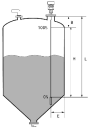
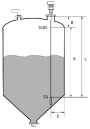
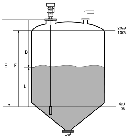
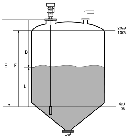
H—-Measurement range L—-Empty tank distance B—-Top blind area E—-Minimum distance from probe to tank wall
The top blind area refers to the minimum distance between the highest material level and the measurement reference point.
The bottom blind zone refers to a section of distance near the very bottom of the cable where precise measurement is not possible.
The effective measurement distance lies between the top blind zone and the bottom blind zone.
Note:
Only when the material is located between the top blind zone and the bottom blind zone can reliable measurement of the material level in the tank be ensured.
Main Parameters
Parameters: Operating frequency: 6.8GHZ
Measurement range: Cable type: 0-30m; Rod type, coaxial type: 0-6m
Repeatability: ±0.1% ±0.2% ±0.3% ±0.5%
Resolution: 1mm
Sampling: echo sampling at 55 times/s
Response speed: >0.2S (subject to specific usage conditions)
Output current signal: 4-20mA
Accuracy:<0.1%
Communication interface: HART communication protocol
Process connection: G1½A/G2A/1½NPT
Flanges DN50, DN80, DN100, DN150
Process pressure: -1-40 bar
Power Supply: 24VDC (±10%)
Ripple voltage: 1Vpp
Power consumption: max 22.5mA
Environmental conditions: Temperature -40℃ to +80℃
Explosion-proof/Protection Level: EXiaIICT6/IP68
Two-wire system wiring: The instrument power supply and signal output share a single two-core shielded cable
Cable entry: 2 M20×1.5 (cable diameter 5-9mm)